Publications
This section includes a list of the latest IPNA scientific articles published in journals included in the Science Citation Index (SCI).
In DIGITAL.CSIC, institutional repository of the CSIC, you can find the complete list of scientific articles since 1962, as well as other collections of interest such as congresses, theses, books, informative material, etc. of the centre. The aim of DIGITAL.CSIC is to organize, preserve and disseminate in open access the results of our research.
In the institutional repository of the CSIC, you can find the complete list of scientific articles, as well as other collections of interest such as congresses, theses, books, informative material, etc.
Analysis of the IPNA 2014-2019 Scientific Production: bibliometric analysis from data collected in Scopus and Web of Science.

Himalayan megathrust geometry and relation to topography revealed by the Gorkha earthquake
The Himalayan mountain range has been the locus of some of the largest continental earthquakes, including the 2015 magnitude 7.8 Gorkha earthquake. Competing hypotheses suggest that Himalayan topography is sustained and plate convergence is accommodated either predominantly on the main plate boundary fault, or more broadly across multiple smaller thrust faults. Here we use geodetic measurements of surface displacement to show that the Gorkha earthquake ruptured the Main Himalayan Thrust fault. The earthquake generated about 1 m of uplift in the Kathmandu Basin, yet caused the high Himalaya farther north to subside by about 0.6 m. We use the geodetic data, combined with geologic, geomorphological and geophysical analyses, to constrain the geometry of the Main Himalayan Thrust in the Kathmandu area. Structural analyses together with interseismic and coseismic displacements are best explained by a steep, shallow thrust fault flattening at depth between 5 and 15 km and connecting to a mid-crustal, steeper thrust. We suggest that present-day convergence across the Himalaya is mostly accommodated by this fault—no significant motion on smaller thrust faults is required. Furthermore, given that the Gorkha earthquake caused the high Himalayan mountains to subside and that our fault geometry explains measured interseismic displacements, we propose that growth of Himalayan topography may largely occur during the ongoing post-seismic phase.

Elliott, J. R.; Jolivet, R.; González, P. J.; Avouac, J.-P.; Hollingsworth, J.; Searle, M. P.; Stevens, V. L.
Chemical and biocidal characterization of two cultivated Artemisia absinthium populations with different domestication levels
The objective of this study was the characterization and valorization of the essential oil from a domesticated Artemisia absinthium population (Teruel, Spain), and its comparison with another one (Sierra Nevada, Spain) undergoing the domestication process. These populations are being experimentally cultivated in the same field since 2008. We studied their biomass and essential oil production (Clevenger hydrodistillation, HD and semi-industrial vapor-pressure, VP). The domesticated population showed lower chemical variation and higher biomass and essential oil yields, allowing for the registration of a new plant variety. The observed variations in oil composition (HD, VP) between the two populations were mostly quantitative. The oils were characterized by the presence of cis-epoxyocimene, (-)-. cis-chrysanthenol, chrysanthenyl acetate, linalool and trans-caryophyllene. The insect antifeedant (. Leptinotarsa decemlineata, Spodoptera littoralis, Myzus persicae and Rhopalosiphum padi) and antifungal (. Fusarium spp. and Botrytis cinerea) effects of their oils were also tested. All VP extracts showed strong antifungal effects and the active antifungal compounds have been identified.

Julio, Luis F.; Burillo Alquézar, Jesús; Giménez, C.; Cabrera, Raimundo; Díaz, Carmen E.; Sanz Perucha, Jesús; González-Coloma, Azucena
Microwave-Assisted Organocatalyzed Rearrangement of Propargyl Vinyl Ethers to Salicylaldehyde Derivatives: An Experimental and Theoretical Study
The microwave‐assisted imidazole‐catalyzed transformation of propargyl vinyl ethers (PVEs) into multisubstituted salicylaldehydes is described. The reaction is instrumentally simple, scalable, and tolerates a diverse degree of substitution at the propargylic position of the starting PVE. The generated salicylaldehyde motifs incorporate a broad range of topologies, spanning from simple aromatic monocycles to complex fused polycyclic systems. The reaction is highly regioselective and takes place under symmetry‐breaking conditions. The preparative power of this reaction was demonstrated in the first total synthesis of morintrifolin B, a benzophenone metabolite isolated from the small tree Morinda citrifolia L. A DFT study of the reaction was performed with full agreement between calculated values and experimental results. The theoretically calculated values support a domino mechanism comprising a propargyl Claisen rearrangement, a [1,3]‐H shift, a [1,7]‐H shift (enolization), a 6π electrocyclization, and an aromatization reaction.

Tejedor, David; Cotos, Leandro ; Márquez-Arce, Daniel; Odriozola-Gimeno, Mikel; Torrent-Sucarrat, Miquel; Cossío, Fernando P.; García-Tellado, Fernando
Prins Cyclization Catalyzed by a Fe(III)/TMS System: the Oxocarbenium Ion Pathway versus the [2+2] Cycloaddition
The different factors that control the alkene Prins cyclization catalyzed by iron(III) salts have been explored by means of a joint experimental–computational study. The iron(III) salt/trimethylsilyl halide system has proved to be an excellent promoter in the synthesis of crossed all‐cis disubstituted tetrahydropyrans, minimizing the formation of products derived from side‐chain exchange. In this iron(III)‐catalyzed Prins cyclization reaction between homoallylic alcohols and non‐activated alkenes, two mechanistic pathways can be envisaged, namely the classical oxocarbenium route and the alternative [2+2] cycloaddition‐based pathway. It is found that the [2+2] pathway is disfavored for those alcohols having non‐activated and non‐substituted alkenes. In these cases, the classical pathway, via the key oxocarbenium ion, is preferred. In addition, the final product distribution strongly depends upon the nature of the substituent adjacent to the hydroxy group in the homoallylic alcohol, which can favor or hamper a side 2‐oxonia‐Cope rearrangement.
Pérez, Sixto J.; Purino, Martín; Miranda, Pedro O.; Martín, Víctor S.; Fernández, Israel; Padrón, Juan I.
The 2014–2015 eruption of Fogo volcano: Geodetic modeling of Sentinel‐1 TOPS interferometry
After 20 years of quiescence, Fogo volcano erupted in November 2014. The eruption produced fast‐moving lava flows that traveled for several kilometers and destroyed two villages. This event represents the first episode of significant surface deformation imaged by the new European Space Agency's Sentinel‐1 satellite in its standard acquisition mode, Terrain Observation by Progressive Scans (TOPS), which differs from that of previous synthetic aperture radar (SAR) missions. We perform a Bayesian inversion of Sentinel‐1 TOPS SAR interferograms spanning the eruption and accurately account for variations in the TOPS line‐of‐sight vector when modeling displacements. Our results show that magma ascended beneath the Pico do Fogo cone and then moved laterally toward its southwestern flank, where the eruptive fissure opened. This study provides important insights into the inner workings of Fogo volcano and shows the potential of Sentinel‐1 TOPS interferometry for geophysical (e.g., volcano monitoring) applications.

González, Pablo J.; Bagnardi, Marco; Hooper, Andrew J.; Larsen, Yngvar; Marinkovic, Petar; Samsonov, Sergey V.; Wright, Tim J.
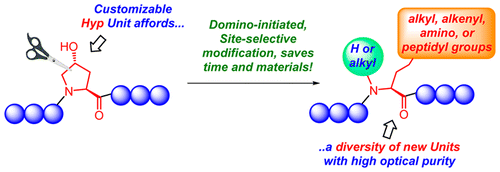
Domino Process Achieves Site-Selective Peptide Modification with High Optical Purity. Applications to Chain Diversification and Peptide Ligation
The development of peptide libraries by site-selective modification of a few parent peptides would save valuable time and materials in discovery processes but still is a difficult synthetic challenge. Herein, we introduce natural hydroxyproline as a convertible unit for the production of a variety of optically pure amino acids, including expensive N-alkyl amino acids, homoserine lactones, and Agl lactams, and to achieve the mild, efficient, and site-selective modification of peptides. A domino process is used to cleave the customizable Hyp unit under mild, metal-free conditions. Both terminal and internal positions can be modified, and similar customizable units can be differentiated. The resulting products possess two reactive chains which can be manipulated independently. The versatility and scope of this process is highlighted by its application to the ligation of two peptide chains, and the generation of peptides with several chains and peptides with conformational restrictions.
Romero Estudillo, Iván Omar; Boto, Alicia
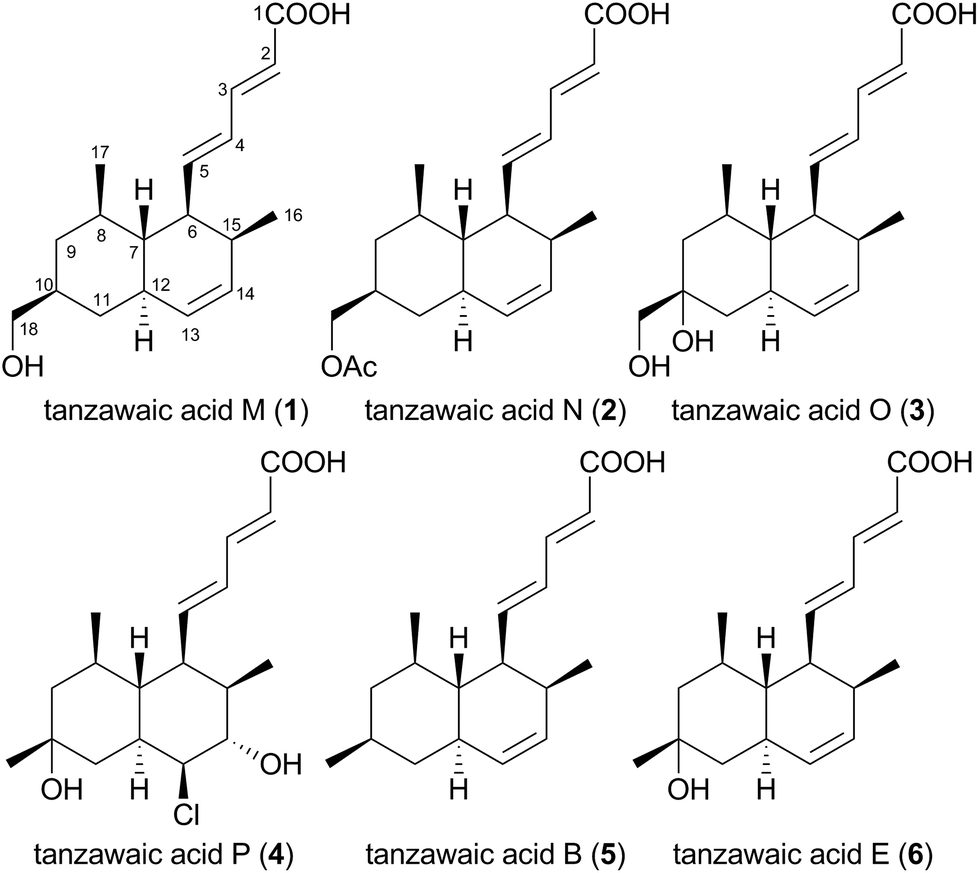
Tanzawaic acids isolated from a marine-derived fungus of the genus Penicillium with cytotoxic activities
Tanzawaic acids M (1), N (2), O (3) and P (4) and the known tanzawaic acids B (5) and E (6), have been isolated from an extract of a cultured marine-derived fungus (strain CF07370) identified as a member of the genus Penicillium. The structures of 1–4 were determined based on spectroscopic evidence. The antimicrobial and cytotoxic activities of compounds 1–6 were evaluated.
Cardoso-Martínez, F.; Rosa, José M. de la; Díaz-Marrero, Ana R.; Darias, José; Cerella, Claudia; Diederich, Marc; Cueto, Mercedes
Chemoselective Intramolecular Functionalization of Methyl Groups in Nonconstrained Molecules Promoted by N-Iodosulfonamides
Mechanistic evidence observed in Hofmann–Löffler–Freytag-type reactions has been crucial to achieve the chemoselective functionalization of methyl groups under mild conditions. Radical-mediated methyl iodination and subsequent oxidative deiodination are the key steps in this functionalization, where iodine chemistry has a pivotal role on the formation of the C–N bond. The concepts of single hydrogen atom transfer (SHAT) and multiple hydrogen atom transfer (MHAT) are introduced to describe the observed chemoselectivity.

Paz, Nieves R.; Rodríguez Sosa, Dionisio; Valdés, Haydée; Marticorena, Ricardo; Melián, Daniel; Copano, Belén; González Martín, Concepción C.; Herrera, Antonio J.
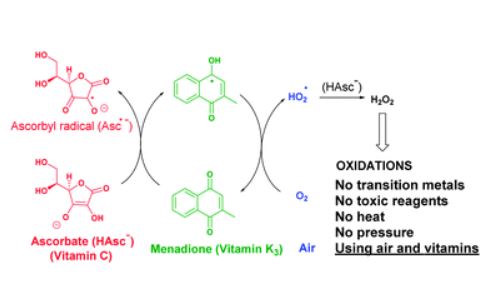
Oxidation with air by ascorbate-driven quinone redox cycling
Transition metal-free oxidation with air at room temperature has been achieved by simply using ascorbate (vitamin C) and catalytic amounts of menadione (vitamin K3). A combination of the mentioned vitamins transforms atmospheric oxygen into hydrogen peroxide, which is able to oxidize arylboronic acids and other chemical moieties.
G. Silveira-Dorta, D. M. Monzón, F. P. Crisóstomo, T. Martín, V. S. Martín, R. Carrillo
Easy access to modified cyclodextrins by an intramolecular radical approach
A simple method to modify the primary face of cyclodextrins (CDs) is described. The 6I‐O‐yl radical of α‐, β‐, and γ‐CDs regioselectively abstracts the H5II, located in the adjacent D‐glucose unit, by an intramolecular 1,8‐hydrogen‐atom‐transfer reaction through a geometrically restricted nine‐membered transition state to give a stable 1,3,5‐trioxocane ring. The reaction has been extended to the 1,4‐diols of α‐ and β‐CD to give the corresponding bis(trioxocane)s. The C2‐symmetric bis(trioxocane) corresponding to the α‐CD is a stable crystalline solid whose structure was confirmed by X‐ray diffraction analysis. The calculated geometric parameters confirm that the primary face is severely distorted toward a narrower elliptical shape for this rim.

Álvarez-Dorta, Dimitri; León, Elisa I.; Kennedy, Alan R.; Martín, Ángeles; Pérez-Martín, Inés; Suárez, Ernesto