Image

Instituto de Productos Naturales y Agrobiología
This commentary argues for strengthening the dialogue between the social and natural sciences as part of a more comprehensive sustainable approach to ecological farming practices that go beyond a focus on specific labels and certifications. It nuances the approach provided by Home et al. in their study of Swiss farms converting to organic agriculture, in emphasizing the need to deepen the study of such farming practices by including a broad vision of global value chains and a pragmatic approach to innovation and the different stakeholders involved. Ultimately, it calls for a more complex approach to eco-agriculture in its widest sense, that goes beyond dichotomies about conversion, certification and labeling. This would provide alternatives for researchers and other actors to move forward in theory and practice.
Alonso-González, Pablo; Parga-Dans, Eva
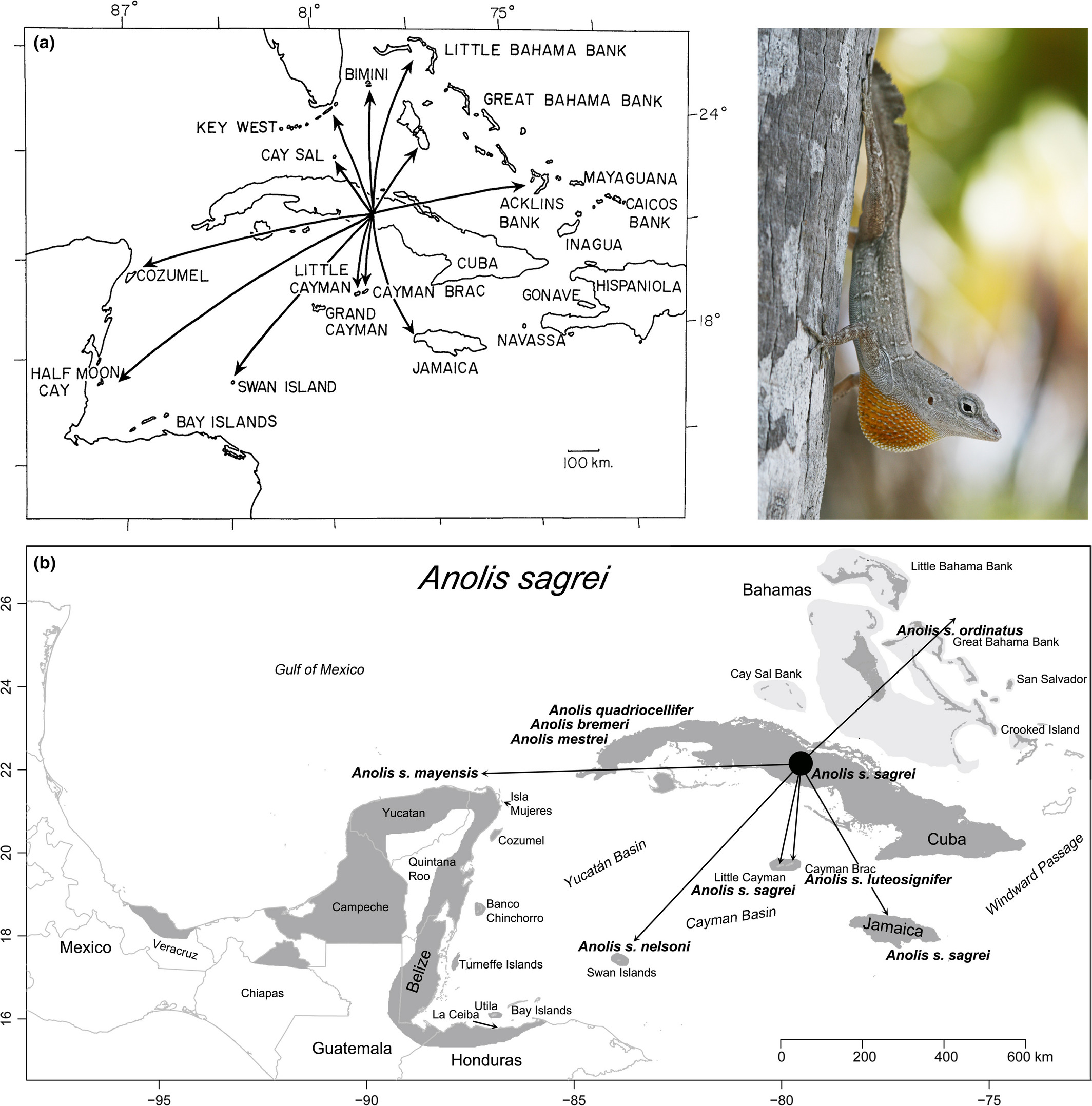
Some of the most important insights into the ecological and evolutionary processes of diversification and speciation have come from studies of island adaptive radiations, yet relatively little research has examined how these radiations initiate. We suggest that Anolis sagrei is a candidate for understanding the origins of the Caribbean Anolis adaptive radiation and how a colonizing anole species begins to undergo allopatric diversification, phenotypic divergence and, potentially, speciation. We undertook a genomic and morphological analysis of representative populations across the entire native range of A. sagrei, finding that the species originated in the early Pliocene, with the deepest divergence occurring between western and eastern Cuba. Lineages from these two regions subsequently colonized the northern Caribbean. We find that at the broadest scale, populations colonizing areas with fewer closely related competitors tend to evolve larger body size and more lamellae on their toepads. This trend follows expectations for post‐colonization divergence from progenitors and convergence in allopatry, whereby populations freed from competition with close relatives evolve towards common morphological and ecological optima. Taken together, our results show a complex history of ancient and recent Cuban diaspora with populations on competitor‐poor islands evolving away from their ancestral Cuban populations regardless of their phylogenetic relationships, thus providing insight into the original diversification of colonist anoles at the beginning of the radiation. Our research also supplies an evolutionary framework for the many studies of this increasingly important species in ecological and evolutionary research.
Graham Reynolds, Robert; Kolbe, Jason J.; Glor, Richard E.; López-Darias, Marta; Gómez Pourroy, Verónica C.; Harrison, Alexis S.; de Queiroz, Kevin; J. Revell, Liam; B. Losos, Jonathan
Biological invasions are one of the main causes of biodiversity loss, especially on oceanic islands. Ants are among the most damaging pests in the world. After systematic sampling of more than 1,000 localities in the Canary Islands, six new exotic ant species are reported for the first time: Pheidole bilimeki (Myrmicinae), Pheidole navigans (Myrmicinae), Strumigenys membranifera (Myrmicinae), Brachymyrmex cordemoyi (Formicinae), Tapinoma darioi (Dolichoderinae) and Technomyrmex pallipes (Dolichoderinae). Moreover, another two recently reported species have been genetically confirmed. Morphological and genetic data were analysed to confirm the identity of the new records. For each species, information regarding identification, distribution, global invasive records and possible impacts is given. The arrival of these species may endanger local biodiversity.
Hernández-Teixidor, David; Pérez-Delgado, Antonio José; Suárez, Daniel; Reyes-López, Joaquin
Nocturnal pollination plays an important role in sexual plant reproduction but has been overlooked, partially because of intrinsic difficulties in field experimentation. Even less attention has received the effect of within-inflorescence spatial position (distal or proximal) on nocturnal pollinators of columnar plants, despite numerous studies examining the relationship between such position and reproductive success. Woody endemic Echium simplex possesses large erect inflorescences bearing thousands of flowers which are visited by a wide array of diurnal and nocturnal animals. In this study, we identified nocturnal visitors and compared their pollination effectiveness with that of diurnal pollinators in different inflorescence sections by means of selective exclosures in NE Tenerife (Canary Islands). Nocturnal visitors included at least ten morphospecies of moths (such as Paradrina rebeli and Eupithecia sp.), two coleopteran species (mainly Alloxantha sp.), neuropterans (Chrysoperla carnea), dictyopterans (Phyllodromica brullei), dermapterans (Guanchia sp.) and julidans (Ommatoiulus moreletii). In general, plants excluded from pollinators set less fruits than open-pollination (control) plants which set fruits homogeneously across sections. Diurnally pollinated plants set more fruit in their upper parts whereas nocturnally pollinated plants set fruit in both upper and bottom sections. We conclude that although the frequency and diversity of diurnal pollinators is far higher than that of nocturnal pollinators, both exhibit different foraging behaviour that generates complementary effects on the reproductive success of E. simplex.
Jaca, Julia; Nogales, Manuel; Traveset, Anna
Two new dipluran species of the family Campodeidae have been unearthed in the Canary Islands. Remycampa herbanica sp. nov. was found in a highly threatened lava tube on Fuerteventura island. It is related to the soil-dwelling northwest African Remycampa launeyi that also inhabits four of the Canary Islands. The two known Remycampa species are characterized by a torsion of the labial palps. They differ chiefly in the distribution of macrosetae and in the features of cave adaptation of R. herbanica, i.e. elongation of body and appendages, and a higher number of olfactory chemoreceptors with a coniform shape unique within campodeids. Spaniocampa relicta sp. nov. was collected in the mesovoid shallow substratum (MSS) and has been assigned to a formerly monotypic genus that includes the soil-dwelling Spaniocampa prima from the Republic of Guinea. The two species differ in the number of abdominal macrosetae. Females of S. relicta sp. nov. have small setae arranged in groups along the posterior border of the first urosternite. These structures of unknown function have never been described in other campodeid species. Sequencing the COI barcode region of R. herbanica has been produced but it proved insufficient to identify closest relatives. The two new hexapods from subterranean habitats raise the Canarian campodeid fauna to six species. Five of them are living in soil and/or MSS, whereas the cave-adapted R. herbanica is known only from a single, particularly endangered lava tube distant from other caves.
Sendra, Alberto; López, Heriberto; Selfa, Jesús; Oromí, Pedro
Botanical and fungal biopesticides, including endophytes, are in high demand given the current restrictive legislations on the use of chemical pesticides. As part of an ongoing search for new biopesticides, a series of fungal endophytes have been isolated from selected medicinal plants including Lauraceae species. In the current study, an extract from the endophytic fungus Trichoderma sp. EFI 671, isolated from the stem parts of the medicinal plant Laurus sp., was screened for bioactivity against plant pathogens (Fusarium graminearum, Rhizoctonia solani, Sclerotinia sclerotiorum and Botrytis cinerea), insect pests (Spodoptera littoralis, Myzus persicae, Rhopalosiphum padi) and plant parasites (Meloidogyne javanica), with positive results against M. persicae. The chemical study of the neutral fraction of the active hexane extract resulted in the isolation of a triglyceride mixture (m1), eburicol (2), β-sitostenone (3), ergosterol (4) and ergosterol peroxide (5). The free fatty acids present in the acid fraction of the extract and in m1 (oleic, linoleic, palmitic and stearic) showed strong dose-dependent antifeedant effects against M. persicae. Liquid (potato dextrose broth, PDB and Sabouraud Broth, SDB) and solid (corn, sorghum, pearl millet and rice) growth media were tested in order to optimize the yield and bioactivity of the fungal extracts. Pearl millet and corn gave the highest extract yields. All the extracts from these solid media had strong effects against M. persicae, with sorghum being the most active. Corn media increased the methyl linoleate content of the extract, pearl millet media increased the oleic acid and sorghum media increased the oleic and linoleic acids compared to rice. The antifeedant effects of these extracts correlated with their content in methyl linoleate and linoleic acid. The phytotoxic effects of these extracts against ryegrass, Lolium perenne, and lettuce, Lactuca sativa, varied with culture media, with sorghum being non- toxic.
Kaushik, Nutan; Díaz, Carmen E.; Chhipa, Hemraj; Fernando Julio, L.; Fe Andrés, M.; González-Coloma, Azucena
The anomeric alkoxyl radical β-fragmentation (ARF) of carbohydrates possessing an electron-withdrawing group (EWG) at C2, promoted by PhI(OAc)2/I2, gives rise to an acyclic iodide through which a pentavalent atom of phosphorus can be introduced via the Arbuzov reaction. After selective hydrolysis and subsequent cyclization, the phosphonate or phosphinate intermediates can be converted into 2-deoxy-1-phosphahexopyranose and 2-deoxy-1-phosphapentopyranose sugars. The ARF of carbohydrates with an electron-donor group (EDG) at C2 proceeds by a radical-polar crossover mechanism, and the cyclization occurs by nucleophilic attack of a conveniently positioned phosphonate or phosphinate group to the transient oxocarbenium ion. This alternative methodology leads to 5-phosphasugars with a 4-deoxy-5-phosphapentopyranose framework. The structure and conformation of the 2-oxo-1,2-oxaphosphinane and 2-oxo-1,2-oxaphospholane ring systems in different carbohydrate models have been studied by NMR and X-ray crystallography.
Hernández-Guerra, Daniel; Kennedy, Alan R.; León, Elisa I.; Martín, Ángeles; Pérez-Martín, Inés; Rodríguez Morales, María S.; Suárez, Ernesto
In this study, we describe a novel strategy that allows the obtention of all 15 possible substitution geometries of perarylated salicylaldehydes with total control of the regioselectivity. This strategy entitles the formation of the salicylaldehyde core via a Claisen rearrangement of propargyl vinyl ethers, followed by bromination and Pd-catalyzed aryl–aryl cross-coupling reactions.
Tejedor, David; Delgado-Hernández, Samuel; Santamaría-Peláeza, Blanca; García-Tellado, Fernando
BPEC is an R package for Bayesian phylogeographic and ecological clustering which allows geographical, environmental and phenotypic measurements to be combined with deoxyribonucleic acid (DNA) sequences in order to reveal geographic structuring of DNA sequence clusters consistent with migration events. DNA sequences are modelled using a collapsed version of a simplified coalescent model projected onto haplotype trees, which subsequently give rise to constrained clusterings as migrations occur. Within each cluster, a multivariate Gaussian distribution of the covariates (geographical, environmental, phenotypic) is used. Inference follows tailored reversible jump Markov chain Monte Carlo sampling so that the number of clusters (i.e., migrations) does not need to be pre-specified. A number of output plots and visualizations are provided which reflect the posterior distribution of the parameters of interest. BPEC also includes functions that create output files which can be loaded into Google Earth. The package commands are illustrated through an example dataset of the polytypic Near Eastern brown frog Rana macrocnemis analyzed using BPEC.
Manolopoulou, Ioanna; Hille, Alex; Emerson, Brent C.
Lizards have been reported as important pollinators on several oceanic islands. Here we evaluate the potential role of Galápagos lava lizards (Microlophus spp.) as pollinators across their radiation. Over 3 years, we sampled pollen transport by 9 lava lizard species on the 10 islands where they are present, including 7 single‐island endemics. Overall, only 25 of 296 individuals sampled (8.4%) transported pollen of 10 plant species, the most common being Prosopis juliflora, Exodeconus miersii, Sesuvium sp. and Cordia leucophlyctis. At least 8 of these plant species were native, and none were confirmed as introduced to the archipelago. Despite the low overall proportion of individuals carrying pollen, this was observed in 7 of the nine lizard species, and on 8 of the ten main islands (Española, Fernandina, Floreana, Isabela, Marchena, Pinta, Santa Cruz and Santiago), suggesting that this is a widespread interaction. The results reported here support the potential role of lava lizards as pollinators across their radiation, although they may represent a relatively modest contribution when compared with birds and insects. However, we cannot discard that lizards may be ecologically significant for particular plant species and ecosystems given the specific climatic condition and functional diversity of each island.
Hervías-Parejo, Sandra; Nogales, Manuel; Guzmán, Beatriz; Trigo, María del Mar; Olesen, Jens M.; Vargas Pablo; Heleno, Rubén H.; Traveset, Anna